
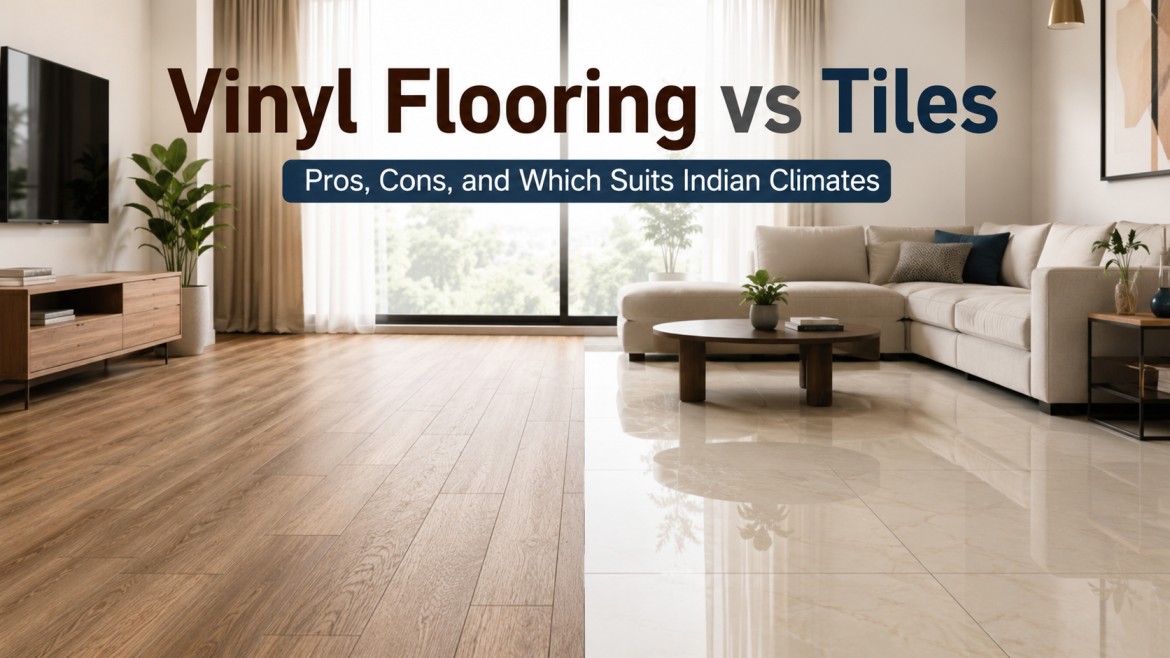
When choosing a flooring material for an Indian home, the debate almost always narrows down to two options: vinyl flooring or tiles. Both have loyal supporters. Both have genuine drawbacks. Picking the right one is not really about which material is objectively superior. It is about which one suits your room, your budget, and most importantly, your climate.
Indian homes face a unique set of conditions. Coastal cities like Mumbai and Thane deal with months of monsoon humidity every year. Inland cities like Delhi and Nagpur swing between scorching summers and cold winters. Flooring sits underfoot every single day, so the wrong choice does not just look bad. It can crack, warp, or develop mould within a few years.
This guide breaks down vinyl flooring vs tiles India comparisons across cost, durability, comfort, and climate performance, so you can make a decision that holds up for the next decade. Flooring is rarely chosen in isolation, though. It usually comes up once a broader renovation is already underway. Maksideo’s step-by-step interior design process can show you exactly where material decisions like this one fit into the bigger timeline.
Outline
- What Are Vinyl Flooring and Tiles, Exactly?
- Vinyl Flooring: Pros and Cons for Indian Homes
- Tiles: Pros and Cons for Indian Homes
- Vinyl Flooring vs Tiles: Cost Comparison in India
- Which Flooring Works Best in Indian Climates?
- Room-by-Room Guide: Vinyl Flooring vs Tiles India
- FAQ’s
- Conclusion
What Are Vinyl Flooring and Tiles, Exactly?
Vitrified tiles, in fact, are the default flooring choice across most Indian homes today. They are made by firing a mixture of clay and minerals at extremely high temperatures, which produces a dense, low-porosity surface that resists water absorption far better than older ceramic tiles. Because of this, vitrified tiles have largely replaced traditional ceramic and ordinary marble in mid-range Indian housing.
Vinyl flooring, on the other hand, is a broader category. It includes basic sheet vinyl, LVT (Luxury Vinyl Tile), LVP (Luxury Vinyl Plank), and SPC (Stone Plastic Composite) — a newer, rigid-core variant that has gained popularity in Indian homes over the last two to three years. Unlike tiles, vinyl floors are installed as a floating floor, meaning they sit on top of your existing surface without cement or grout, which significantly reduces both installation time and mess.
Vinyl Flooring: Pros and Cons for Indian Homes
Pros of Vinyl Flooring
- Warmer underfoot: Unlike tiles, vinyl does not feel cold even in winter, which makes it considerably more comfortable for bedrooms and living rooms.
- Faster installation: Vinyl uses a click-lock or glue-down system, so a room can be floored in a single day. There’s no dust, cement, or curing time to wait out.
- Genuinely waterproof in rigid-core form: Modern SPC vinyl is 100% waterproof through its entire thickness, not just on the surface. It does not warp or swell even in humid Mumbai conditions.
- Quieter and softer: Vinyl flooring absorbs footstep sound better than hard tile, which matters in apartments with shared walls or upper floors.
- Easy to install over existing floors: Vinyl floats over the subfloor, so installers can often lay it directly over old tiles, avoiding the cost and mess of demolition.
Cons of Vinyl Flooring
- Lower resale perception: However premium, vinyl flooring does not carry the same resale value association as stone or tile in the Indian real estate market.
- Heat and direct sunlight sensitivity: Cheaper vinyl can discolour or soften slightly under prolonged direct sunlight. Balconies and uncovered terraces are not ideal locations for it.
- Scratches from heavy furniture: SPC resists dents well, but lower-grade vinyl can scratch under heavy furniture legs without protective pads.
- Limited lifespan compared to tile: Good vinyl flooring typically lasts 10 to 15 years. Vitrified tiles, by contrast, can easily last 20 years or more with proper care.
Tiles: Pros and Cons for Indian Homes
Pros of Tiles
- Proven durability: Vitrified tiles have been the standard in Indian construction for decades, with long-term performance in Indian climates that’s well established.
- Excellent for wet areas: Tiles remain the safest choice for kitchens, bathrooms, and balconies. They handle constant water exposure without any risk of warping.
- Higher resale value perception: Indian homebuyers and real estate agents generally view tiled or stone flooring as a stronger long-term investment than vinyl.
- Wide design range: From marble-look vitrified to textured matt finishes, tiles now offer almost as much visual variety as vinyl, while staying significantly more scratch-resistant.
- Naturally cooler underfoot: In hot inland cities, tiles stay cool even during peak summer, which many Indian households actually prefer.
Cons of Tiles
- Cold and hard underfoot: The same coolness that helps in summer becomes a discomfort in winter, particularly in northern Indian cities.
- Longer, messier installation: Tile laying needs cement, grout, and curing time. This can take several days and generates significant construction dust.
- Grout maintenance: If you don’t seal and clean grout lines regularly, they collect dirt and can develop mould in humid bathrooms.
Risk of cracking: Tiles can crack under heavy impact or if the subfloor shifts slightly. Replacing a single cracked tile rarely matches the surrounding floor perfectly.
Vinyl Flooring vs Tiles: Cost Comparison in India
| Flooring Type | Cost (Rs/sq.ft, installed) | Lifespan | Best Suited For |
| Sheet Vinyl | Rs. 40–90 | 8–12 years | Budget rooms, rentals |
| LVT / LVP Vinyl | Rs. 80–180 | 10–15 years | Bedrooms, living rooms |
| SPC Vinyl | Rs. 120–250 | 15–20 years | All rooms, humid zones |
| Ceramic Tile | Rs. 40–100 | 10–15 years | Budget bathrooms, kitchens |
| Vitrified Tile | Rs. 60–250 | 20+ years | Living room, whole home |
| Marble-Look Vitrified | Rs. 150–400 | 20+ years | Premium living spaces |
Note: All costs are approximate estimates for the MMR region (Mumbai, Thane, Navi Mumbai), inclusive of material and standard installation. Costs vary by city, brand, subfloor condition, and finish quality.
These figures cover flooring alone, of course. Labour, design fees, and other materials all add to the final number, so treat this table as one input into a larger budget rather than the full picture.
Which Flooring Works Best in Indian Climates?
India is not a single climate. Coastal cities deal with persistent humidity and heavy monsoon rainfall for months at a time. Inland cities face dry heat and dust instead. The right flooring choice genuinely depends on where you live, not just what looks good in a showroom.
Here is what actually works well, region by region:
Climate-by-Climate Breakdown
- In humid coastal cities such as Mumbai, Thane, and Goa, SPC vinyl performs reliably because its rigid core does not absorb moisture or swell. Vitrified tiles work equally well here and remain the default choice for wet zones like kitchens and bathrooms.
- In hot, dry inland cities such as Delhi, Jaipur, and Nagpur, tiles and stone flooring stay cooler underfoot during peak summer, which is often preferred. Vinyl can still work well in bedrooms where warmth underfoot matters more than cooling.
- In cities with cold winters, such as parts of North India, vinyl flooring offers a genuine comfort advantage, since it does not turn icy cold the way tile and stone do.
- For ground-floor homes or homes prone to seepage, SPC vinyl or vitrified tile both outperform laminate or solid wood, since neither has wood fibre that can swell from rising dampness.
Choosing the Right Grade of Vinyl
One practical note, however: budget-grade sheet vinyl is not the same product as rigid-core SPC vinyl, even though both fall under the umbrella term ‘vinyl flooring.’ Always confirm whether the product you are quoted is SPC, LVT, or basic sheet vinyl. Their water resistance and durability differ significantly. Vinyl and tiles are not the only two materials suited to Indian climates, either. Marble stays notably cooler in hot inland regions. Engineered wood can work in drier, cooler pockets of the country. Our broader best flooring options for Indian homes roundup covers how each material handles different regional conditions, in case neither vinyl nor tile turns out to be the right fit for your specific city.
Room-by-Room Guide: Vinyl Flooring vs Tiles India
Living Room
The living room sees the most foot traffic in most Indian homes, which is why durability matters as much as appearance here. Large-format vitrified tiles remain a strong default choice, offering scratch resistance and a premium look. However, SPC vinyl plank flooring is increasingly chosen for living rooms that want a warmer, wood-look finish without the cost of real hardwood.
Bedroom
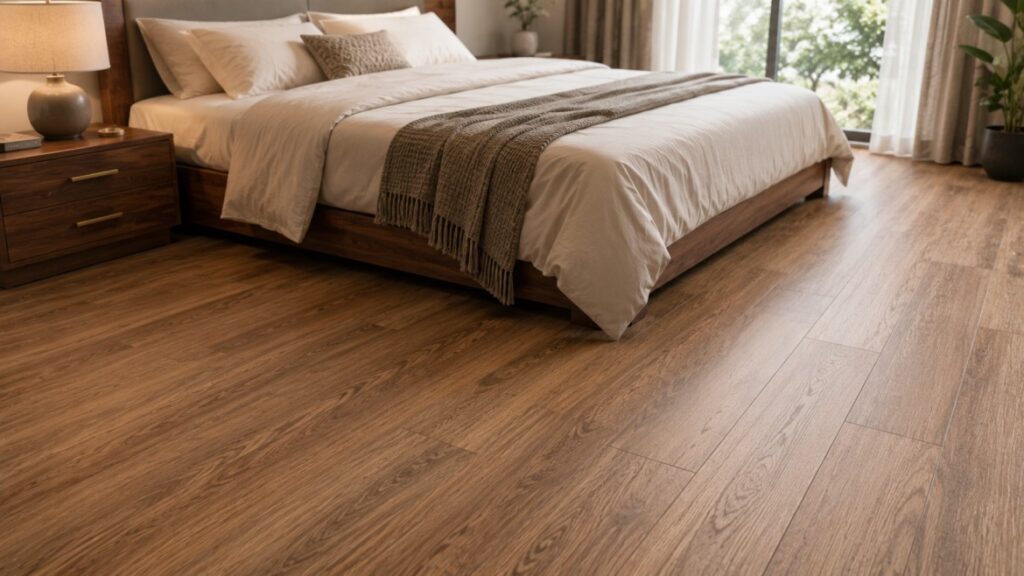
Bedrooms are where vinyl flooring genuinely shines. Since comfort underfoot matters more than abrasion resistance in a room used mostly while barefoot, vinyl plank flooring in warm wood tones creates a noticeably cosier feel than cold tile. Sound absorption is an added benefit, particularly in apartments with shared walls.
Kitchen
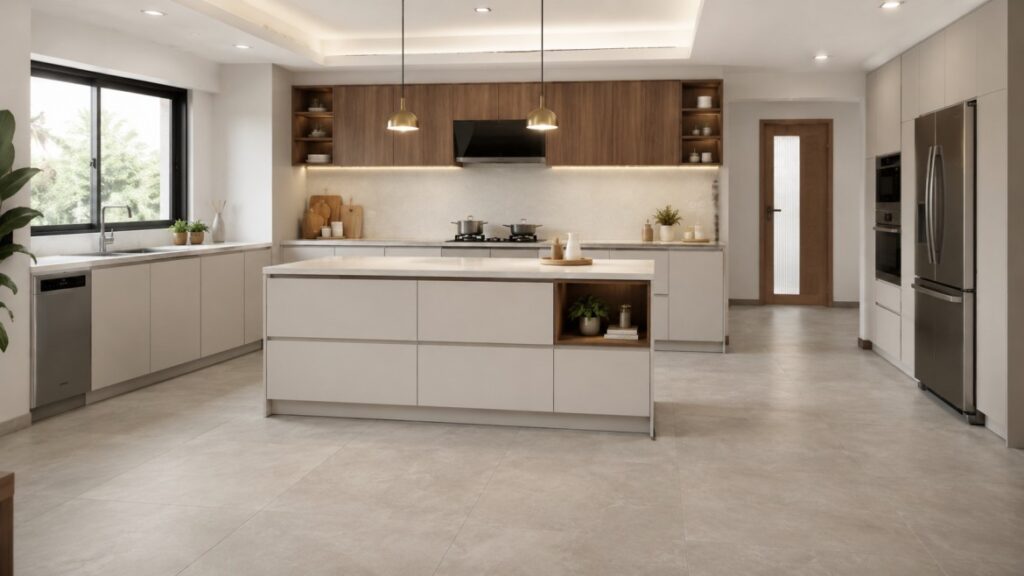
Kitchens deal with spills, oil, and dropped utensils daily, which makes water resistance and impact resistance equally important. Anti-skid matt vitrified tile remains the safer choice here. If vinyl is preferred for warmth, SPC — not basic sheet vinyl — is the only acceptable grade for kitchen use.
Bathroom
Bathrooms are the one room where tiles still clearly outperform vinyl in most Indian households. Anti-skid ceramic or vitrified tile, rated R10 or higher for slip resistance, is the safer standard, particularly for homes with children or elderly residents. Vinyl can technically be waterproof, but its locking seams are a long-term risk in constant-wet conditions.
Home Office
Home offices benefit from vinyl’s quieter, warmer surface, especially for long hours of seated work. SPC vinyl plank in a neutral wood tone also photographs well for video calls, giving the room a polished, professional backdrop without the cold, echoey feel of bare tile.
FAQ’s
Rigid-core SPC vinyl flooring is genuinely waterproof and performs well in India’s humid coastal climate, including Mumbai’s monsoon season. Basic sheet vinyl and budget LVT, however, offer only partial water resistance and are not recommended for constant-wet areas like bathrooms.
Installed costs overlap significantly. Basic vinyl and ceramic tile both start around Rs. 40 per sq. ft., while premium SPC vinyl (Rs. 120–250/sq.ft) and vitrified tile (Rs. 60–250/sq.ft) compete closely. Vinyl typically saves on labour cost since it skips cement and grouting.
Good-quality SPC vinyl flooring typically lasts 15 to 20 years with proper care, while vitrified tiles can last 20 years or more. Basic sheet vinyl has a shorter lifespan of 8 to 12 years and is more prone to wear in high-traffic areas.
Yes. Most vinyl flooring, including SPC, can be installed directly over existing tile floors as long as the surface is clean, flat, and free of major cracks or unevenness. This significantly reduces renovation time and avoids the cost of tile removal.
Both SPC vinyl and vitrified tile handle Mumbai’s monsoon humidity well, since neither material has wood fibre that swells with moisture. Vitrified tile remains the safer choice for kitchens and bathrooms specifically, while SPC vinyl is excellent for bedrooms and living rooms.
Vinyl flooring, including premium SPC, generally does not carry the same resale value perception as vitrified tile or natural stone in the Indian real estate market. For homes intended for resale, tile flooring in common areas is usually the safer long-term investment.
Conclusion
Overall, there is no single winner in the vinyl flooring vs tiles debate — the right choice depends entirely on the room, the city, and the budget. Indeed, many Indian homes today use both: vitrified tile in kitchens and bathrooms, paired with SPC vinyl in bedrooms and home offices, getting the strengths of each material exactly where it matters most.
Therefore, start by mapping out moisture exposure room by room, then match material to climate and usage. Above all, never compromise on water resistance in kitchens and bathrooms regardless of which flooring family you ultimately choose.
At Furnofy, accordingly, we help homeowners across Mumbai, Thane, and Navi Mumbai choose flooring that performs well in Indian conditions while staying within budget. So, if you are planning a renovation and want expert guidance on vinyl flooring vs tiles for your home, reach out to us.