
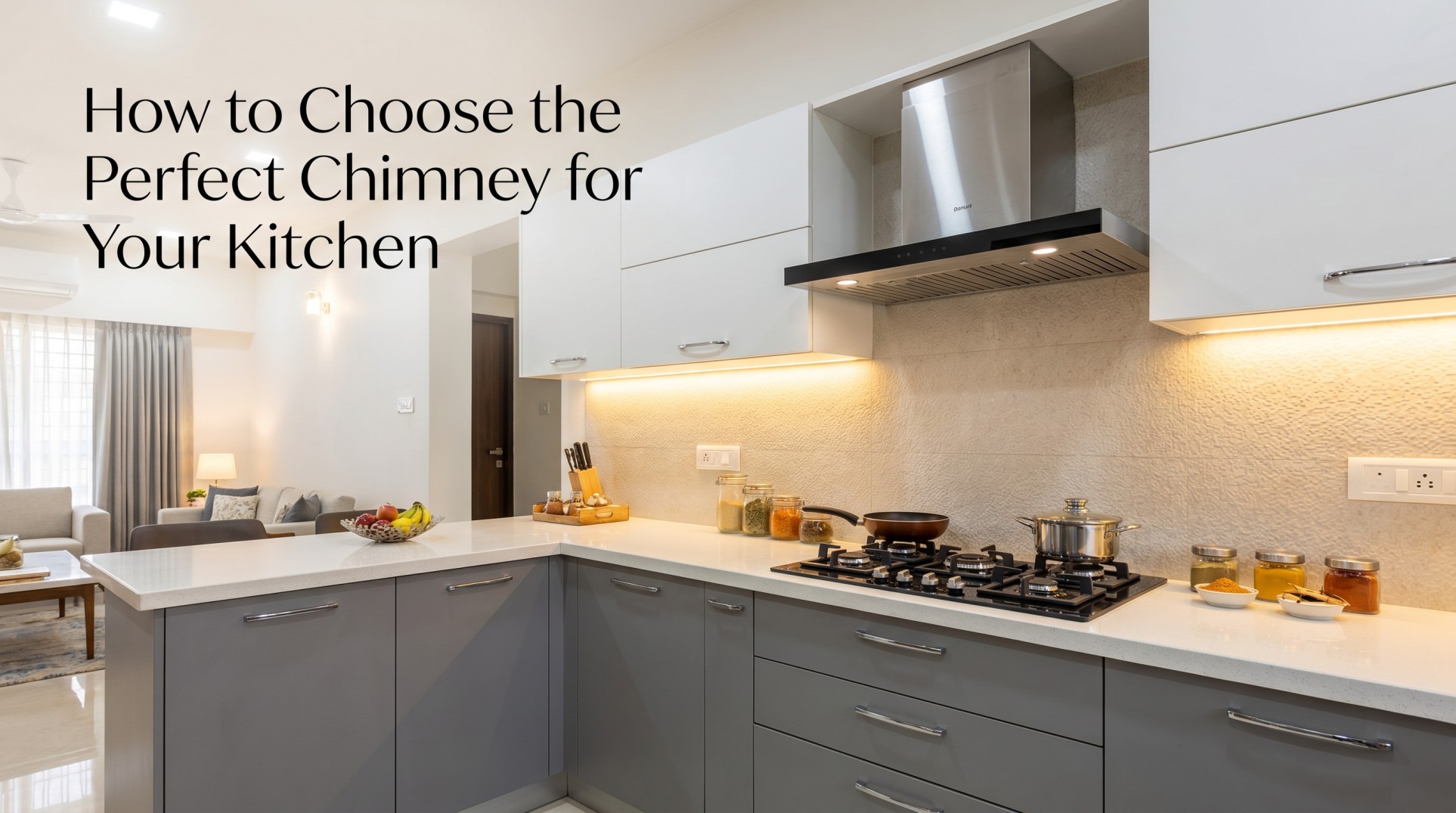
If you’ve ever cooked a batch of tadka or deep-fried pakoras and watched smoke fill up your kitchen within minutes, you already know why a chimney isn’t optional — it’s essential. Yet, most people buy one in a rush, pick the wrong size or suction power, and spend years dealing with a greasy exhaust that barely works.
Choosing the right kitchen chimney isn’t complicated, but it does require knowing what to look for. In this guide, Furnofy breaks it all down simply — types, sizes, suction power, filters, maintenance — so you can make a confident, well-informed decision.
Outline
- Why Every Indian Kitchen Needs a Chimney
- Types of Kitchen Chimneys
- Key Factors to Consider Before You Buy
- How to Maintain Your Kitchen Chimney
- Best Kitchen Chimney Brands in India
- Conclusion
Why Every Indian Kitchen Needs a Chimney
Indian cooking is intense. Between the high-flame tadkas, deep-frying, and aromatic masalas, your kitchen produces more smoke, grease, and odour than most other cuisines in the world. Without a chimney, all of that ends up coating your walls, ceiling, cabinets, and eventually your lungs.
Because of this, a kitchen chimney is not just a lifestyle upgrade — it’s a health investment. Moreover, it protects your kitchen surfaces from grease buildup, which means less cleaning effort and a longer life for your cabinets and paint.
Additionally, if you have an open kitchen or a kitchen that connects to a living or dining area, a chimney becomes even more critical. It keeps the cooking smells contained and makes the entire home more comfortable.
Types of Kitchen Chimneys
Before anything else, it helps to understand which type of chimney suits your kitchen layout. Here’s a clear breakdown
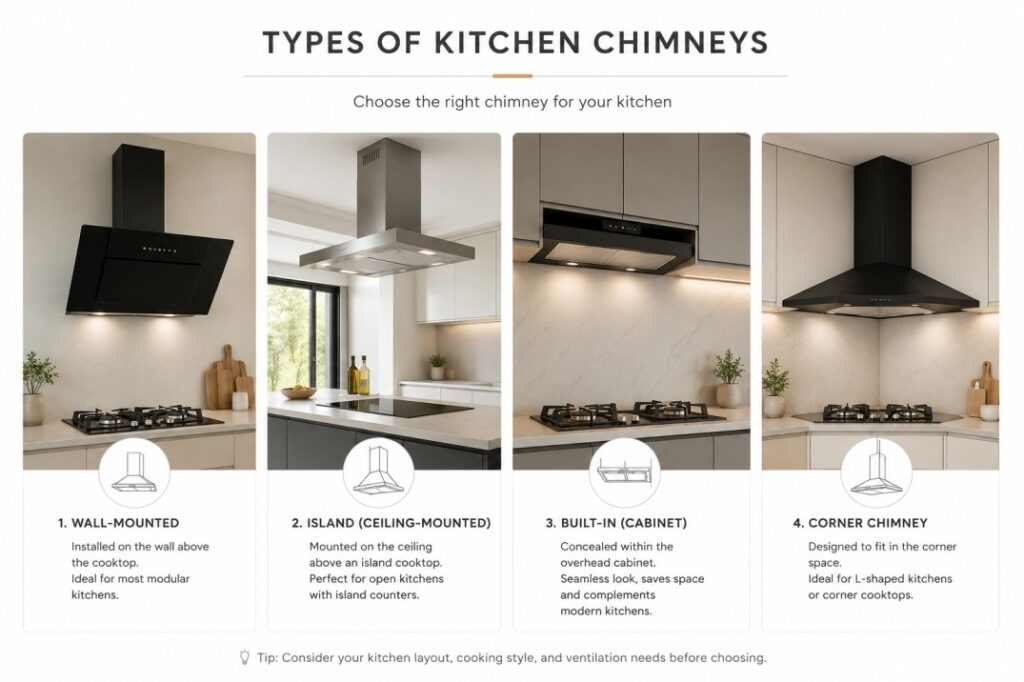
Wall-Mounted Chimney
This is by far the most common type in Indian homes. It mounts directly on the wall above your cooking range and vents smoke outside through a duct. Wall-mounted chimneys come in a wide range of styles — from sleek stainless steel to glass canopy designs — and are straightforward to install.
Best for: Standard kitchens where the hob sits against a wall.
Island Chimney
If your kitchen has an island hob — placed in the centre of the kitchen rather than against a wall — you need an island chimney. These are ceiling-mounted and tend to be larger and more visually striking. Furthermore, they work well in open-plan kitchens and add a premium look to the space.
Best for: Open kitchens and island cooking setups.
Built-In Chimney
Built-in chimneys are integrated seamlessly into kitchen cabinetry. They sit hidden behind a cabinet door or panel, revealing only the ventilation area above the hob. Consequently, they offer the cleanest, most minimalist aesthetic of all the chimney types.
Best for: Modular kitchens with a minimalist or contemporary design.
Corner Chimney
Designed specifically for corner hob placements, corner chimneys are an excellent solution for compact kitchens where space is at a premium. They fit neatly into the corner without wasting any countertop or wall space.
Best for: Small or compact kitchens with a corner cooking setup.
Ductless (Recirculating) Chimney
Unlike other types, ductless chimneys do not vent air outside. Instead, they filter the air through carbon filters and recirculate clean air back into the kitchen. They are particularly useful in apartments or rental homes where drilling for ducts is not an option.
Best for: Apartments and rental properties where external ducting isn’t possible.
Key Factors to Consider Before You Buy
Size — Match It to Your Hob
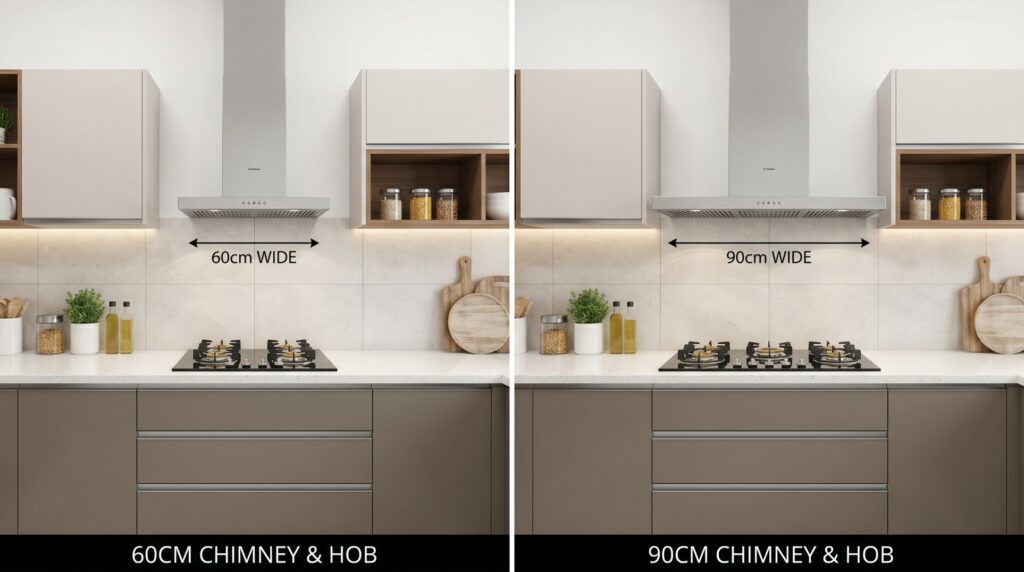
The golden rule: your chimney should be at least as wide as your hob, if not slightly wider. A chimney that’s narrower than your cooking range will miss smoke and grease at the edges, reducing its effectiveness significantly.
- 60 cm chimney — ideal for 2 or 3 burner hobs in small kitchens
- 75 cm chimney — works well for standard 4 burner hobs in medium kitchens
- 90 cm chimney — best for large hobs, wide cooking ranges, or heavy cooking
Suction Power — The Most Important Spec
Suction power is measured in cubic metres per hour (m³/h) and tells you how much air the chimney can process. For Indian cooking — which tends to be heavier on smoke, oil, and heat than Western cooking — you want a chimney with strong suction power.
- Under 100 sq ft kitchen — 400 to 600 m³/h is sufficient
- 100 to 150 sq ft kitchen — aim for 600 to 800 m³/h
- Above 150 sq ft or heavy cooking — go for 800 to 1000 m³/h
Moreover, if you do a lot of deep frying, grilling, or high-flame cooking, always choose one step up from the recommended range. The extra suction capacity is worth it.
Filter Type — Choose Wisely
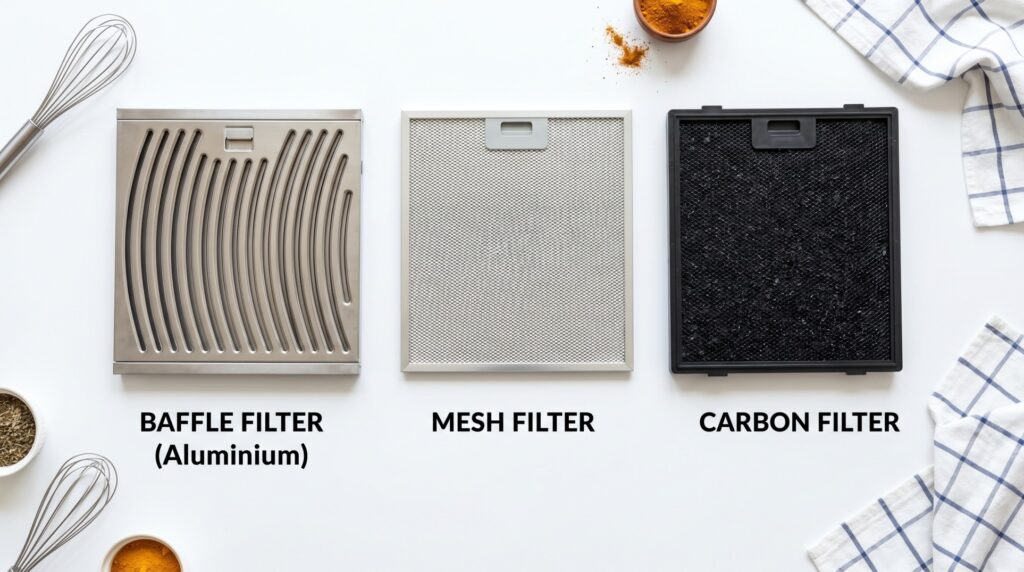
The filter is what separates smoke, grease, and odour from the air. There are three main types, and the right one depends on your cooking style:
Baffle Filters: The best choice for Indian cooking. They use curved panels to change the direction of airflow, causing grease to separate and drip into a collection tray. They are easy to clean — just pop them in the dishwasher or soak in hot water. Furthermore, they last for years without needing replacement.
Mesh Filters: Made from layered aluminium mesh, these are budget-friendly but require frequent cleaning. They are not as effective as baffle filters for heavy-duty cooking and tend to clog faster.
Carbon Filters: Used exclusively in ductless chimneys to absorb odours. They do not remove grease on their own and need to be replaced every 6 months. Consequently, they add to the long-term running cost of your chimney.
Noise Level — Often Ignored, Always Regretted
Nobody thinks about chimney noise until they turn it on at full power during a dinner party and can’t hear themselves think. Chimney noise is measured in decibels (dB), and anything above 65 dB at high speed can feel intrusive.
- Below 55 dB — very quiet, suitable for open kitchens connected to living spaces
- 55 to 65 dB — standard range, acceptable for most kitchens
- Above 65 dB — noticeably loud, usually found in high-suction budget models
Premium brands invest in noise-reduction technology, so you generally get a quieter chimney as you move up in price.
Design and Aesthetics
Your chimney sits at eye level in the kitchen — it’s one of the most visible appliances in the room. Therefore, the design matters, especially in open or modular kitchens.
- Stainless steel finish — timeless, easy to clean, works with most kitchen styles
- Black glass canopy — modern and dramatic, great for dark-themed or contemporary kitchens
- Built-in panel finish — seamless, minimal, blends with cabinetry
Additionally, consider the control panel style. Touch controls look cleaner but can be harder to operate when your hands are oily. Motion-sensor controls are a premium feature worth considering if you cook daily.
How to Maintain Your Kitchen Chimney
A chimney that isn’t cleaned regularly loses suction power fast. Here’s a simple maintenance routine to follow:
- Clean baffle or mesh filters every 2 to 3 weeks — hot water and dish soap work well
- Replace carbon filters every 6 months if you use a ductless chimney
- Wipe down the exterior with a damp cloth weekly to prevent grease buildup
- Check the duct for blockages every 6 months to ensure smooth airflow
- Run the chimney on low speed for a few minutes after cooking — it clears residual smoke from the duct
Best Kitchen Chimney Brands in India
When it comes to reliability and performance, these brands consistently rank well in the Indian market:
- Faber — Premium build quality, wide range of designs, excellent after-sales service.
- Elica — Known for quiet motors and stylish European designs that suit modern Indian kitchens.
- Hindware — Offers strong performance at accessible price points — a great mid-range choice.
- Kaff — Built specifically with Indian cooking in mind — high suction power and durable filters.
- Bosch — Premium pricing, but the build quality and noise levels are among the best available.
- Siemens — Sleek, efficient, and whisper-quiet — ideal for open kitchens where noise matters.
Furthermore, most of these brands offer warranties of 2 to 5 years on the motor, which is a good indicator of their confidence in the product’s durability.
Conclusion
Choosing the right kitchen chimney comes down to four things: the right size for your hob, enough suction power for your cooking style, a filter that suits your maintenance routine, and a design that fits your kitchen’s look.
For most Indian kitchens, a 60 to 90 cm wall-mounted chimney with a baffle filter and 700+ m³/h suction is the sweet spot. It handles everyday Indian cooking efficiently, requires minimal upkeep, and lasts for years.
At Furnofy, we believe your kitchen should work as well as it looks. So invest in the right chimney once, maintain it well, and enjoy a smoke-free, grease-free kitchen every single day.