

If you have been staring at flat, painted walls and wondering why your room still feels incomplete, the answer is probably texture. A plain painted wall certainly does the job, but a textured wall, in contrast, changes the mood of the entire space. As a result, it adds depth, character, and visual interest that paint alone cannot achieve.
Indeed, wall texture design ideas for Indian homes have moved well beyond basic putty work. Today, for instance, homeowners across Mumbai, Thane, Pune, and the broader MMR region are choosing textured finishes that solve real problems — hiding uneven surfaces, masking minor cracks, reducing repainting frequency, and, importantly, holding up through harsh monsoon seasons.
Therefore, in this guide, you will find every major wall texture type used in Indian homes, along with their approximate costs per square foot, which finishes genuinely hold up in our climate, and finally, a room-by-room breakdown of what works where.
If you are planning a full home renovation rather than a single accent wall, it helps to see how texture fits into a complete end-to-end interior design process, from material selection through execution.
Outline
- What Is Wall Texture and Why Does It Matter in Indian Homes?
- Popular Wall Texture Design Types for Indian Homes
- More Wall Texture Options: Popcorn, Metallic, and Stucco
- Wall Texture Cost Comparison: India (2024–25)
- Which Wall Texture Works Best in Indian Homes?
- Room-by-Room Guide to Wall Texture Design Ideas India
- FAQ‘s
- Conclusion
What Is Wall Texture and Why Does It Matter in Indian Homes?
In Indian homes, specifically, wall texture solves two problems simultaneously. On the practical side, for example, it covers hairline cracks, rough masonry, and the uneven surfaces that are common after civil work — something almost every Indian home deals with after construction or renovation. On the aesthetic side, meanwhile, it allows homeowners to go well beyond white walls without committing to bold paint colours.
Furthermore, textured walls also age better than flat paint in humid climates. Cities like Mumbai and Thane, for instance, experience heavy monsoons and persistent humidity that cause flat emulsion paint to peel and blister. Consequently, many texture finishes — especially acrylic-modified and cement-based ones — resist moisture far better and need less maintenance over time.
Popular Wall Texture Design Types for Indian Homes
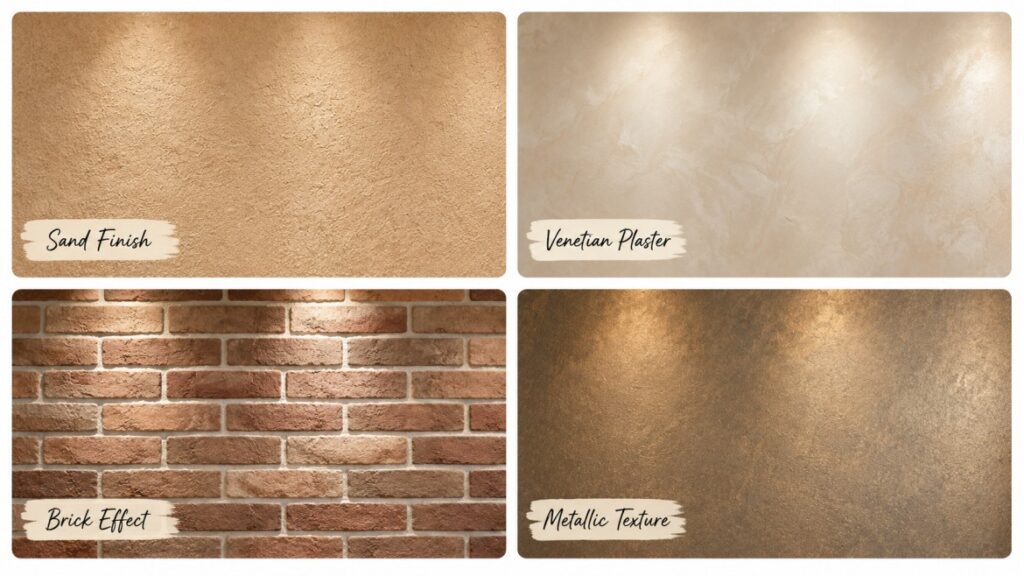
Therefore, before picking a finish, it helps to understand what each texture actually looks like, where it performs best, and what it generally costs. Here are the four most requested wall textures for Indian living rooms and bedrooms.
Sand Finish Texture
Sand finish is, in fact, the most widely used wall texture design in India. The finish mixes fine sand into a paint compound, creating a grainy, matte surface that suits living rooms, bedrooms, and hallways equally well. Because it is easy to apply and easy to repair, it does not require premium labour. As a result, for budget-conscious homeowners, this is almost always the right starting point.
Cost estimate: Rs. 20 to Rs. 45 per sq. ft. (material + labour)
Venetian Plaster
Venetian plaster, on the other hand, creates a smooth, marble-like surface with a subtle natural shine. It uses slaked lime mixed with marble dust, which is then applied in multiple thin layers, each burnished by hand. As a result, the finished wall reflects light beautifully and actually improves in appearance over time. Although it works best in living rooms, master bedrooms, and premium hotel-style interiors, skilled application is essential — this is not a DIY finish.
Cost estimate: Rs. 80 to Rs. 200 per sq. ft.
Knockdown Texture
Knockdown texture, meanwhile, uses a skip-trowel technique to create a mottled surface — mostly flat with irregular raised patches. Since it is a subtle, non-loud choice, it works well as a feature wall in Indian homes. In addition, it hides surface irregularities effectively, which makes it particularly practical for older constructions with rough walls.
Cost estimate: Rs. 30 to Rs. 60 per sq. ft.
Brick Effect Texture
Brick effect texture, in contrast, replicates the look of exposed brick using textured paint or plasterwork. Consequently, it adds warmth and an earthy character to dining areas, home offices, and industrial-style living rooms. Specifically, Indian homes with heritage or contemporary-rustic themes benefit the most from this finish.
Cost estimate: Rs. 50 to Rs. 100 per sq. ft.
More Wall Texture Options: Popcorn, Metallic, and Stucco
Beyond the four core finishes above, three more wall texture types are worth considering, especially for ceilings, accent walls, and humidity-prone areas.
Popcorn or Acoustic Texture
Popcorn texture, for instance, creates a bumpy, slightly rough surface. Because it reduces noise and covers surface defects easily, it was widely used in older Indian homes for ceilings. Although it is less common in modern interiors today, it remains useful for home theatres, utility rooms, and compact apartment ceilings, particularly where sound dampening matters.
Cost estimate: Rs. 18 to Rs. 35 per sq. ft.
Metallic Texture Paint
Metallic texture paint, similarly, uses fine shimmer particles in the compound to create a reflective, glittery surface. Asian Paints Royale and Berger Silk Glamour, for example, are popular choices in this category in India. Since these textures work best as single accent walls — behind TV panels, behind bed headboards, or in powder rooms — it is best to use them on one wall only, not all four.
For a closer look at the full range of finishes and special effects available, you can browse Asian Paints’ official Royale Play texture collection.
Cost estimate: Rs. 45 to Rs. 90 per sq. ft.
Stucco Finish
Stucco, finally, is a cement-based textured plaster with a rugged, Mediterranean look. Because of its high moisture resistance, it performs extremely well in coastal cities like Mumbai. Although it is primarily used on exterior walls, it also works equally well inside for entrance lobbies, feature walls in living rooms, and any space with higher humidity exposure.
Cost estimate: Rs. 40 to Rs. 75 per sq. ft.
Wall Texture Cost Comparison: India (2024–25)
| Texture Type | Cost (Rs/sq.ft) | Durability | Best Suited For |
| Sand Finish | Rs. 20–45 | High | All rooms, budget-friendly |
| Venetian Plaster | Rs. 80–200 | Very High | Living room, master bedroom |
| Knockdown | Rs. 30–60 | High | Feature walls, older homes |
| Brick Effect | Rs. 50–100 | Medium-High | Dining room, home office |
| Popcorn / Acoustic | Rs. 18–35 | Medium | Ceilings, home theatre |
| Metallic Texture | Rs. 45–90 | Medium | Accent walls, TV panels |
| Stucco Finish | Rs. 40–75 | Very High | Entrance lobby, exterior |
Note: All costs are approximate estimates for the MMR region (Mumbai, Thane, Navi Mumbai). Costs vary by city, contractor, surface preparation required, and finish quality.
Wall texture is just one line item in a larger renovation budget. For a full breakdown of what drives interior design costs across India — by city, space type, and material choice — see our guide on the cost of interior designing in India.
Which Wall Texture Works Best in Indian Homes?
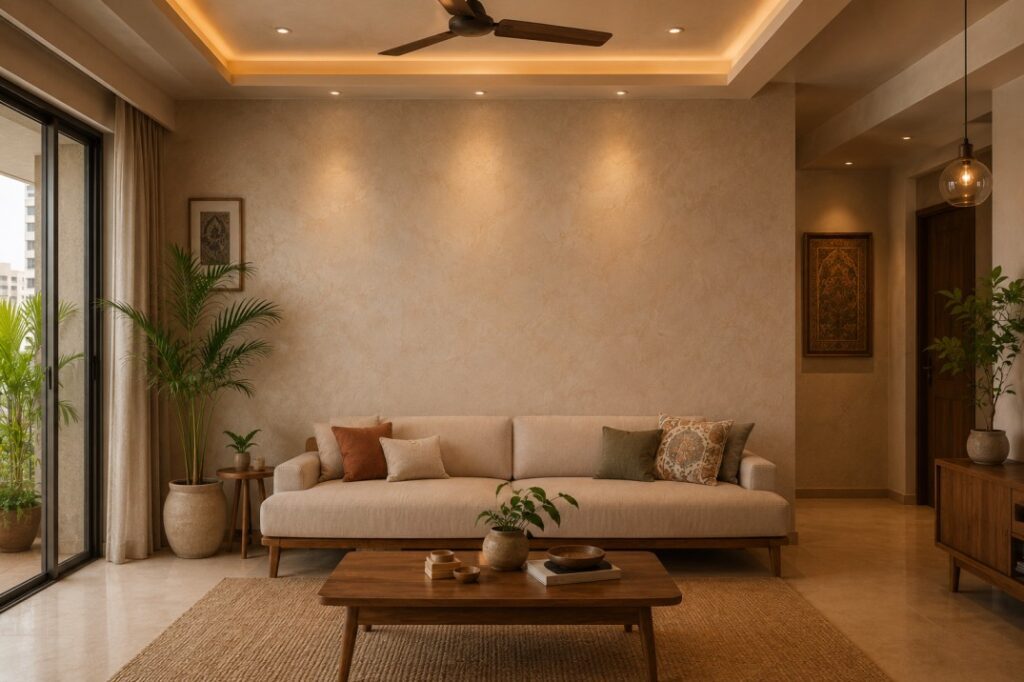
Indian homes, after all, face specific conditions that affect texture performance — high humidity in coastal cities, dust accumulation in inland areas, and wide seasonal temperature swings. Therefore, not every texture that looks great on a design blog will hold up after two monsoons in Mumbai.
Consequently, here is what genuinely works well:
- First, sand finish suits most Indian homes across all budgets. Since it handles humidity reasonably well and is easy to touch up, it does not demand expensive labour. As a result, start here if you are unsure.
- Second, Venetian plaster is worth the investment for living rooms and master bedrooms where you want a premium result. Although it is highly durable and develops a natural patina over time, the quality depends entirely on skill — so hire a trained applicator, not just the right material.
- Similarly, stucco or cement-based textures work best for entrance lobbies, balcony-adjacent walls, and any surface with higher moisture exposure, because they outperform paint-based textures in resistance to dampness and peeling.
- In addition, metallic textures add drama as accent walls. However, use them on one wall per room, never all four. Paired with warm LED lighting, for instance, they work particularly well in bedrooms and drawing rooms.
- Finally, avoid popcorn ceilings in new constructions unless you have a specific acoustic requirement, since they collect dust, resist cleaning, and read as outdated in modern Indian interiors.
One practical note, however: wall texture design ideas that work in a large Delhi villa may not necessarily translate to a 2BHK in Thane. Because compact rooms need subtler finishes, it is best to reserve heavy textures like brick effect and stucco for larger rooms or commercial spaces.
Room-by-Room Guide to Wall Texture Design Ideas India
Living Room
The living room, naturally, is the right place to invest in a bold wall texture design. For example, a Venetian plaster or knockdown feature wall behind the sofa immediately elevates the space. Therefore, keep the remaining three walls in flat or sand finish so the textured wall gets full visual attention. Earthy tones — terracotta, warm beige, sage — pair well with most Indian furniture styles.
Bedroom
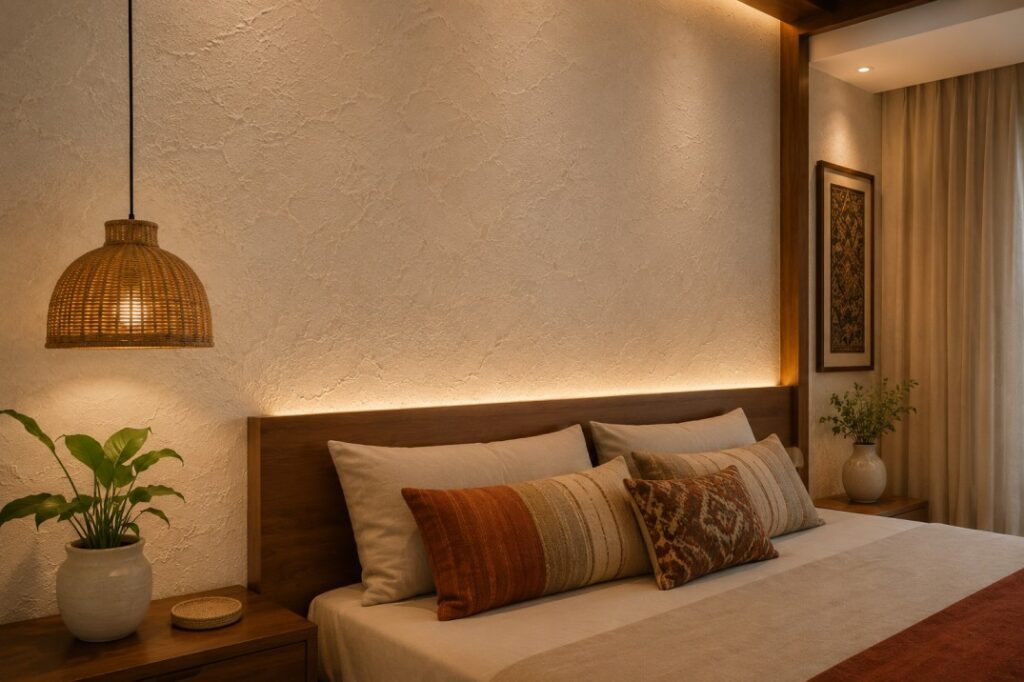
In the bedroom, however, texture should calm the space, not stimulate it. Sand finish in warm white, soft grey, or muted earth tones works best. For something more layered, on the other hand, a subtle metallic or knockdown texture on the headboard wall adds visual depth without disturbing the restful mood of the room.
Kitchen
Most wall textures, unfortunately, are not suited for the area directly behind a cooking stove because of grease and heat. However, the wall on the dining side or opposite the cooking counter can certainly carry a brick effect or sand finish. Instead, use tiles or laminate panels behind the cooking zone.
Bathroom
Generally, it is best to keep texture out of wet zones. Nevertheless, the entrance wall outside a bathroom or a dry wall above a freestanding bathtub can carry Venetian plaster or a light metallic finish. Always, therefore, ensure proper ventilation before applying any texture in semi-wet spaces.
Home Office
Home offices, similarly, benefit from subtle, non-distracting textures. For instance, a soft brick effect or industrial stucco on one wall creates a focused, professional backdrop — particularly useful for video calls. Overall, stick to neutral or muted tones that photograph well without distracting.
FAQ’s
Sand finish is the most commonly used wall texture in Indian homes due to its affordability (Rs. 20–45/sq.ft), durability in humid climates, and ease of application. Venetian plaster is increasingly popular in premium residential projects across Mumbai and Pune.
Wall texture cost in India ranges from Rs. 18 to Rs. 200 per sq. ft. depending on the finish type and local labour rates. Sand finish is the most affordable option. Venetian plaster sits at the premium end. All estimates include both material and application costs.
Yes. Most wall textures can be applied over existing painted walls, provided the surface is clean, dry, and free of flaking paint or dampness. Some finishes like Venetian plaster require a smooth base and may need a primer coat applied first.
Cement-based textures like stucco and acrylic-modified sand finishes perform best in humid coastal climates. They resist moisture better than standard paint-based textures and are less likely to peel, blister, or bubble after the monsoon season.
Yes, for most finishes. Sand finish and knockdown can be applied by an experienced painter. However, Venetian plaster and stucco require trained, skilled applicators. Poor application is the single most common reason textured walls look bad or fail early — invest in the right person, not just the right material.
Sand finish is a budget-friendly, grainy matte texture suitable for all rooms, applied quickly by any experienced painter. Venetian plaster is a premium, multi-layer marble-dust finish with a polished, silk-like sheen — it requires skilled application and costs three to four times more, but delivers a significantly more luxurious result.
Conclusion
Overall, wall texture is one of the most cost-effective upgrades you can make in an Indian home. Indeed, a well-chosen, correctly applied textured wall can transform a room without a full renovation. Therefore, start with the room that matters most — usually the living room. Then, match the texture to your room’s scale, lighting, and furniture. Above all, never cut corners on the applicator.
At Furnofy, accordingly, we help homeowners across Mumbai, Thane, and Navi Mumbai choose wall finishes that look great, perform well in Indian conditions, and stay within budget. So, if you are planning a renovation and want expert guidance on wall texture design ideas for your home, reach out to us.