
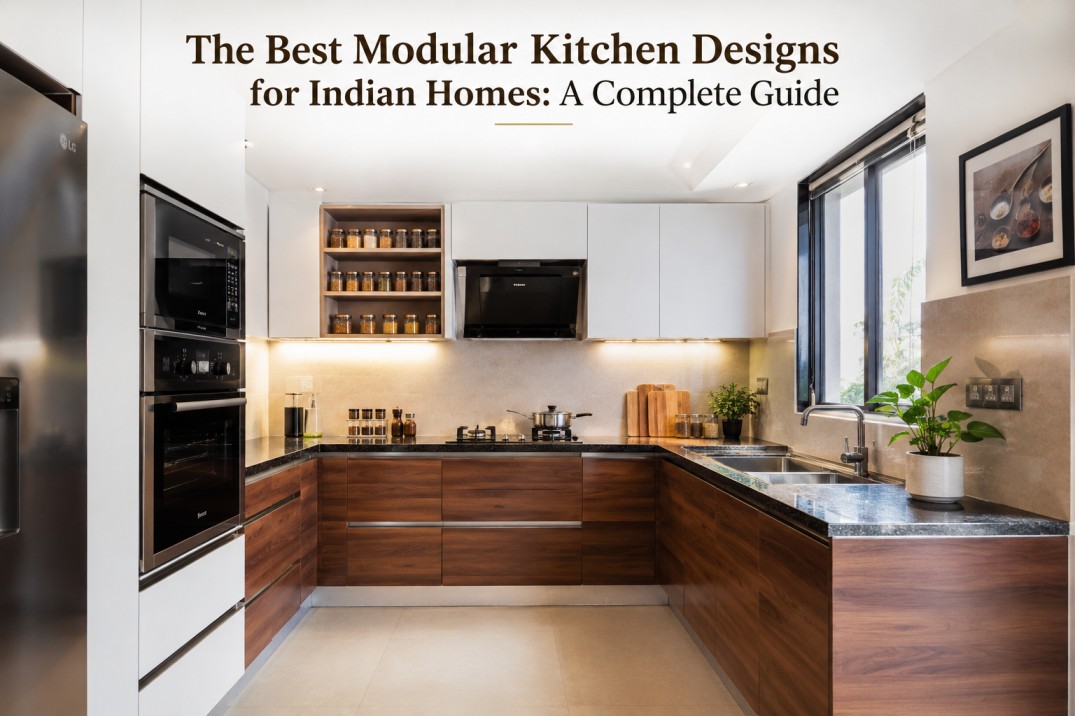
Let’s be honest — the kitchen is the soul of every Indian home. It’s where chai gets made before the rest of the house wakes up, where biryani simmers for hours, and where the family inevitably gravitates during festivals. So it makes complete sense that more and more Indian homeowners are now investing in modular kitchen designs that are both beautiful and genuinely practical.
But with so many layouts, materials, and price points to choose from, picking the right modular kitchen for your home can feel overwhelming. That’s why we’ve put together this no-nonsense guide — to walk you through the best modular kitchen designs for Indian homes, help you figure out what actually works for your space, and give you practical tips to make every square foot count.
Outline
- What Is a Modular Kitchen, Exactly?
- Why Modular Kitchens Work So Well for Indian Homes
- Popular Modular Kitchen Designs for Indian Homes
- L-Shaped Modular Kitchen — The Indian Favourite
- U-Shaped Modular Kitchen — Maximum Counter Space
- Straight-Line Modular Kitchen — Perfect for Compact Spaces
- Parallel Modular Kitchen — Great Workflow, Double the Storage
- Island Modular Kitchen — For Open-Plan Homes That Want to Impress
- Key Factors to Consider Before You Finalise Your Design
- Modular Kitchen Features Worth Every Rupee
- How to Maximise Space in a Modular Kitchen
- Final Thoughts
What Is a Modular Kitchen, Exactly?
A modular kitchen is made up of pre-manufactured units — called modules — that get assembled right in your home. These include base cabinets, wall units, tall units, countertops, and specialised storage like pull-out drawers and corner carousels. Unlike traditional kitchens that are built from scratch, modular kitchens arrive as ready-to-install components, which means faster installation, more consistency, and easier replacement if something gets damaged down the line.
The biggest win? You get a kitchen that looks sharp, uses every inch intelligently, and can be tailored to exactly how your family cooks.
Why Modular Kitchens Work So Well for Indian Homes
Indian cooking is not exactly light work. We’re talking multiple burners running at once, pressure cookers, a dedicated space for a mixer-grinder, separate shelves for masalas, dals, and dry groceries — plus a full-size fridge that needs to be within arm’s reach. A modular kitchen design handles all of this without turning your cooking space into a cluttered mess.
Here’s why modular kitchens are such a good fit for Indian households:
- Space optimisation: Pull-out drawers, corner units, and tall pantry cabinets make sure no space goes to waste — critical in Indian homes where kitchens are often compact.
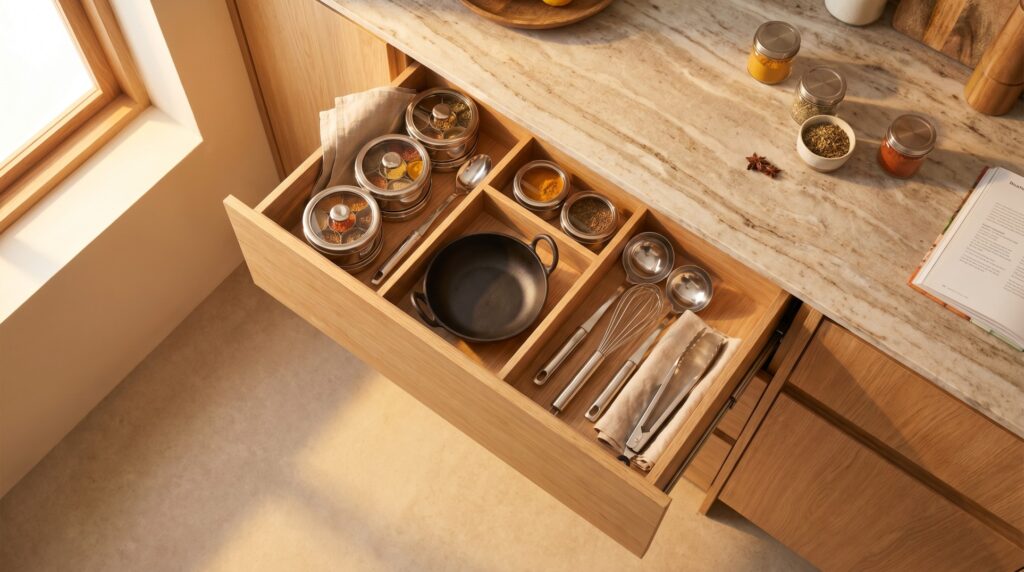
- High customisation: Whether you need a dedicated masala drawer, a larger hob counter, or space for a built-in chimney, modular kitchens can be configured to your specific needs.
- Easy to clean: Smooth laminate and acrylic finishes mean grease and splatters wipe off quickly — something you’ll appreciate after a session of deep frying.
- Modern aesthetic: Modular kitchens instantly upgrade the look of your home. They’re sleek, well-proportioned, and photograph beautifully — important if you love sharing your home on Instagram.
- Efficient work triangle: The cooking zone, cleaning zone, and prep area are arranged so you move less and cook more comfortably.
Popular Modular Kitchen Designs for Indian Homes
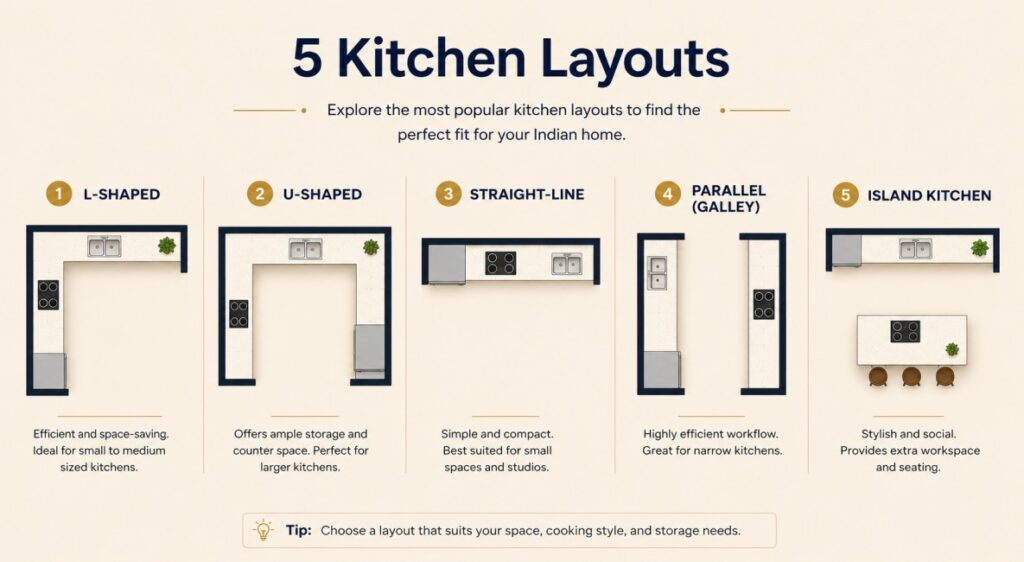
There is no one-size-fits-all when it comes to modular kitchen layouts. The right design depends on the size and shape of your kitchen, how many people cook at once, and how much storage you need. Let’s break down the five most popular options.
L-Shaped Modular Kitchen — The Indian Favourite
If there’s one layout that dominates Indian apartments, it’s the L-shaped kitchen. Cabinets and countertops run along two adjacent walls, forming an “L,” which creates a natural work triangle and keeps the kitchen feeling open. This design also makes it easy to add a breakfast counter on the open side — perfect for quick weekday mornings.
- Ideal for: Small to medium-sized kitchens in 2BHK and 3BHK apartments
- Best feature: Corner space can be optimised with a carousel or magic corner pull-out
- Pro tip: Add a tall unit on one end for pantry storage — it’s a game changer for Indian kitchens that need space for atta, rice, and cooking oils
U-Shaped Modular Kitchen — Maximum Counter Space
The U-shaped layout wraps around three walls and gives you more counter space than any other design. If you love to cook elaborate meals or have two people working in the kitchen simultaneously, this layout genuinely makes a difference. It’s also the best choice for homes with dedicated kitchen rooms rather than open-plan spaces.
- Ideal for: Larger kitchens in independent houses, bungalows, or spacious flats
- Best feature: Separate zones for cooking, prep, and cleaning — no one’s stepping on each other
- Pro tip: Keep the sink and hob on two different walls so the work triangle stays efficient
Straight-Line Modular Kitchen — Perfect for Compact Spaces
Also called a single-wall kitchen, this design lines everything up along one wall. It’s the go-to choice for studio apartments, 1BHKs, and narrow kitchen spaces. While it doesn’t offer the same spread as other layouts, a well-designed straight-line kitchen is surprisingly efficient — especially when tall units and overhead cabinets are used cleverly.
- Ideal for: Studio apartments, compact 1BHKs, and bachelor pads
- Best feature: Minimal footprint, easy to work in alone, and very easy to maintain
- Pro tip: Use a fold-down or pull-out counter to temporarily expand your workspace when needed
Parallel Modular Kitchen — Great Workflow, Double the Storage
A parallel kitchen, sometimes called a galley kitchen, uses two opposite walls with a walkway in between. This layout is genuinely underrated in India. It gives you separate zones on each wall — say, wet work (washing and prep) on one side, and dry work (cooking, storage) on the other. The result is a highly organised and efficient kitchen.
- Ideal for: Long, narrow kitchens in independent houses or larger apartments
- Best feature: Excellent separation of tasks, ideal when two people cook together
- Pro tip: Keep the aisle at least 900mm wide for comfortable movement
Island Modular Kitchen — For Open-Plan Homes That Want to Impress
The island kitchen is the showstopper. A freestanding central unit — the island — serves as extra counter space, a breakfast bar, or even a secondary cooking zone. This design works only in spacious, open-plan kitchens, but when it does work, it completely transforms the look and feel of the space. It’s also a great way to connect the kitchen with the dining or living area.
- Ideal for: Large open-plan homes, penthouses, or luxury residences
- Best feature: Social cooking — the island faces the living space, so you can chat with guests while cooking
- Pro tip: Use the island for storage on the inside and bar seating on one side — double duty, maximum impact
Key Factors to Consider Before You Finalise Your Design
Before you pick a layout, there are a few things worth getting clear on. These decisions will save you a lot of back-and-forth with your designer.
- Kitchen size and shape: This is the starting point. Measure your kitchen accurately, including door and window positions. A 10×8 ft kitchen will call for a completely different layout than a 6×10 ft narrow kitchen.
- Storage needs: Indian kitchens need serious storage — think beyond dishes and cutlery. Plan for your pressure cooker, mixer-grinder, chimney, microwave, water purifier, and all the dry grocery that an Indian pantry demands.
- Material and finish: Laminate is the most popular and affordable option. Acrylic gives a high-gloss premium look. PU-painted cabinets offer the smoothest finish. Each has its own maintenance profile — choose based on how much cooking (and how much oil splatter) your kitchen sees.
- Budget: Modular kitchens in India can range from ₹1.5 lakh for a basic laminate setup to ₹10 lakh or more for a premium acrylic or PU-finish kitchen with branded hardware. Set your budget before meeting vendors, not after.
- Ventilation: Indian cooking produces a lot of smoke and heat. Make sure your chimney is well-positioned and properly sized for your hob — typically 60cm or 90cm depending on the number of burners.
Modular Kitchen Features Worth Every Rupee
Once you’ve sorted the layout, it’s time to think about the add-ons. Some of these features sound like luxuries but genuinely change how you use your kitchen every single day.
- Pull-out pantry unit: This is a non-negotiable for Indian kitchens. A tall, pull-out pantry unit gives you visible, accessible storage for your dals, atta, cooking oils, and snacks. No more digging to the back of a dark cabinet.
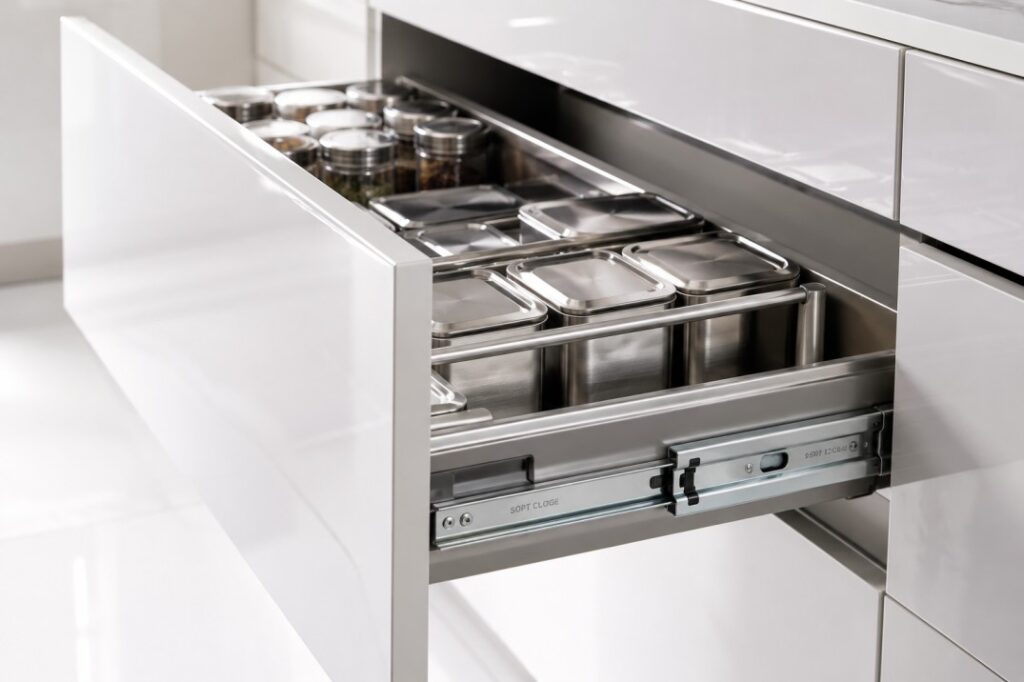
- Soft-close drawers and hinges: They cost a little more but they last significantly longer, reduce noise (no more slamming drawers), and keep your cabinets looking new for years.
- Magic corner or carousel: Corner units in L-shaped and U-shaped kitchens tend to become dead space. A magic corner pull-out or a rotating carousel makes every inch usable.
- Integrated appliances: Building your microwave, dishwasher, or refrigerator into the cabinetry gives the kitchen a seamless, hotel-like finish and avoids the clutter of standalone appliances.
- Under-cabinet lighting: LED strips under your overhead cabinets illuminate the countertop directly — a surprisingly big help when you’re chopping vegetables or reading a recipe.
- Tandem drawers: Deep base cabinets with tandem drawers let you stack and separate cookware, lids, and baking trays neatly instead of piling everything on top of each other.
How to Maximise Space in a Modular Kitchen
Space is almost always limited in Indian kitchens — especially in Mumbai, Bangalore, and Delhi apartments where every square foot comes at a premium. The good news is that a well-designed modular kitchen can feel remarkably spacious even in a compact footprint. Here’s how to make it happen:
- Go vertical: Take your cabinets all the way up to the ceiling. The space above standard overhead cabinets is usually dead storage — use it for rarely needed items.
- Choose lighter colours: Light-coloured cabinets (white, cream, greige) reflect light and make a kitchen feel more open. Reserve dark accents for the countertop or backsplash.
- Use the backsplash smartly: A glass or tile backsplash with an integrated shelf or spice rail adds storage without taking up counter space.
- Install pull-out waste bins: A built-in bin unit under the sink keeps your floor clear and makes segregating wet and dry waste much easier.
- Multi-functional island: If you have room for an island, design it with storage inside and a breakfast counter on one side — two functions, one footprint.
Final Thoughts
Choosing the right modular kitchen design for your Indian home is genuinely one of the best investments you can make. A well-planned kitchen doesn’t just look good in photos — it makes your daily cooking faster, easier, and far more enjoyable. Whether you’re working with a compact 1BHK or a spacious independent home, there’s a modular kitchen layout that fits perfectly.
Start by figuring out your layout based on your kitchen’s shape and size. Then layer in the right storage features and finishes. And don’t forget the little things — soft-close hinges, good lighting, and a pull-out pantry will quietly make your life better every single day.
If you’re planning a kitchen renovation or designing a new kitchen from scratch, our team at Furnofy is happy to help you figure out what works best for your space and budget. Reach out to us — we love talking kitchens.